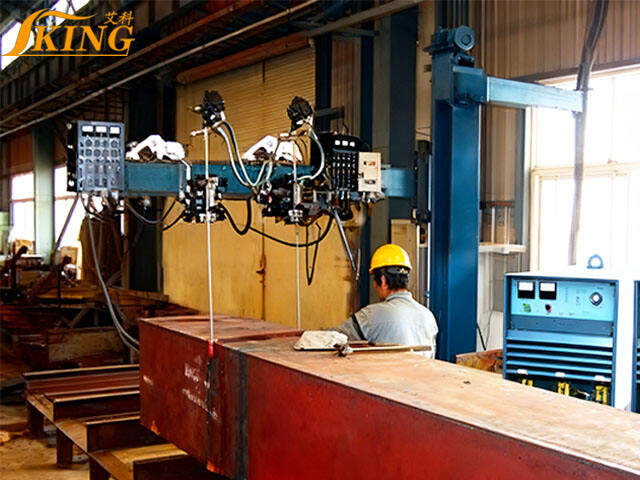
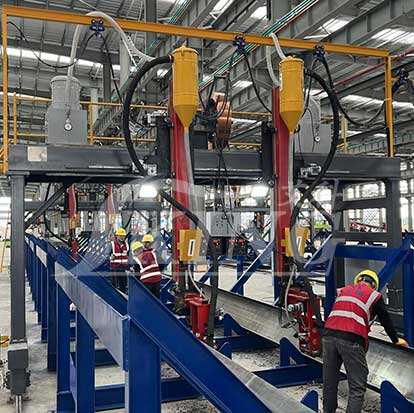
Automated box beam welding machines represent a transformative solution for manufacturers seeking to enhance welding precision while simultaneously reducing operational labor costs. These sophisticated systems combine advanced automation technology with proven welding methodologies to deliver consistent, high-quality results that traditional manual welding processes often struggle to achieve. Understanding how a box beam welding machine accomplishes these dual objectives requires examining the underlying mechanisms that drive both precision improvements and labor cost reductions in modern manufacturing environments.

The financial and operational benefits of implementing automated welding systems extend far beyond simple equipment acquisition costs. A well-designed box beam welding machine fundamentally alters the production equation by eliminating human variability in critical welding parameters while simultaneously reducing the workforce requirements for complex structural welding operations. This comprehensive approach to manufacturing optimization addresses two of the most pressing challenges facing modern fabrication facilities: maintaining consistent quality standards and controlling rising labor expenses.
Modern box beam welding machines utilize sophisticated computerized control systems that maintain precise welding parameters throughout entire production runs. These systems continuously monitor and adjust critical variables such as welding speed, amperage, voltage, and wire feed rate to ensure optimal penetration and bead formation. Unlike manual welding operations where individual welder skill levels and fatigue can introduce significant variations, automated systems maintain consistent parameter settings that eliminate human-induced deviations from specified welding procedures.
The precision control extends to complex geometric considerations that challenge even experienced manual welders. Box beam welding machines incorporate advanced positioning systems that automatically adjust torch angle, travel speed, and standoff distance based on real-time feedback from integrated sensors. This level of precision control ensures that each weld meets exact specifications regardless of the complexity of the joint configuration or the length of the welding sequence.
Automated welding systems deliver unprecedented repeatability in weld quality characteristics that directly translate to improved structural integrity and reduced rejection rates. A properly calibrated box beam welding machine can reproduce identical weld profiles across thousands of production cycles with minimal deviation from established quality standards. This consistency eliminates the variability associated with different welders working on similar components and ensures that every finished product meets the same exacting quality criteria.
The repeatability advantage becomes particularly significant in high-volume production environments where maintaining consistent quality across large production runs is critical for customer satisfaction and regulatory compliance. Quality control personnel can establish precise acceptance criteria knowing that the automated system will consistently deliver welds that meet or exceed these standards without requiring constant supervision or adjustment.
Advanced box beam welding machines incorporate comprehensive monitoring systems that provide real-time feedback on weld quality parameters during the welding process. These systems utilize various sensing technologies including arc voltage monitoring, current feedback, and thermal imaging to detect potential quality issues before they result in defective welds. The immediate feedback capability allows for instant process corrections that maintain optimal welding conditions throughout the entire production cycle.
The monitoring systems also generate detailed data logs that provide valuable insights into process performance trends and help identify opportunities for further optimization. This data-driven approach to quality management enables continuous improvement initiatives that further enhance precision and reduce the likelihood of quality-related production delays or customer rejections.
Implementing a box beam welding machine significantly reduces the number of skilled welders required for complex structural welding operations. Traditional manual welding of box beams typically requires multiple certified welders working in coordination to maintain productivity levels and meet quality standards. Automated systems can perform the same work with minimal operator supervision, allowing manufacturers to redeploy skilled welders to higher-value activities or reduce overall staffing requirements.
The skill requirements for operating automated welding equipment differ significantly from traditional manual welding skills. Operators need training in system programming, setup procedures, and basic maintenance rather than extensive manual welding certification. This shift in skill requirements often allows manufacturers to utilize less expensive technical personnel while maintaining or improving production quality levels.
Automated box beam welding machines typically operate at higher duty cycles than manual welders, resulting in significantly improved productivity and throughput. While human welders require regular breaks and may experience productivity variations throughout their shifts, automated systems can maintain consistent operation for extended periods with only minimal interruptions for material handling and routine maintenance. This increased operational efficiency directly translates to reduced labor costs per unit of production.
The productivity improvements extend beyond simple welding speed considerations. Automated systems eliminate many of the setup and positioning activities that consume significant time in manual welding operations. The box beam welding machine can quickly transition between different joint configurations and automatically adjust positioning without requiring extensive manual intervention, resulting in higher overall equipment effectiveness and improved labor utilization.
Operating automated welding equipment requires significantly less training investment compared to developing skilled manual welders. Certified structural welders typically require years of training and ongoing certification maintenance that represents substantial cost for manufacturing organizations. Box beam welding machine operators can become proficient in system operation within weeks rather than years, reducing training costs and enabling faster workforce development.
The reduced dependence on highly skilled manual welders also provides greater workforce flexibility and reduced vulnerability to skilled labor shortages that frequently impact manufacturing operations. Organizations can more easily maintain production schedules and quality standards when they are not dependent on a limited pool of certified welders who may be difficult to recruit or retain.
Automated welding systems demonstrate superior material utilization efficiency compared to manual welding operations, resulting in reduced consumable costs and material waste. Box beam welding machines precisely control wire feed rates and welding parameters to minimize overwelding while ensuring adequate penetration and strength characteristics. This optimization reduces consumable costs per linear foot of weld while maintaining quality standards that often exceed those achieved through manual welding processes.
The improved material utilization extends to reduced rework and repair requirements that typically consume additional labor and materials in manual welding operations. Consistent weld quality reduces the incidence of defects that require grinding, rewelding, or complete component replacement, resulting in lower overall material costs and improved production efficiency.
Modern box beam welding machines incorporate energy-efficient power supplies and optimized welding processes that reduce overall energy consumption per unit of production. The precise control of welding parameters ensures that energy is applied efficiently without waste, while the improved duty cycles mean that equipment operates at optimal efficiency levels for greater percentages of available production time.
The energy efficiency improvements contribute to reduced operating costs while supporting environmental sustainability initiatives. Lower energy consumption per unit of production directly impacts manufacturing cost structures and can provide competitive advantages in cost-sensitive market segments.
The consistent quality output from automated welding systems eliminates many of the hidden costs associated with quality problems in manual welding operations. Reduced rejection rates, fewer customer complaints, and lower warranty claim frequencies all contribute to improved profitability that extends beyond direct labor cost savings. Box beam welding machine implementation often results in measurable improvements in customer satisfaction metrics that translate to increased repeat business and referral opportunities.
The quality improvements also reduce internal quality control costs by minimizing the inspection requirements and testing procedures necessary to verify weld quality. When automated systems consistently produce acceptable welds, quality assurance personnel can focus on statistical sampling rather than comprehensive inspection of every component, resulting in additional labor cost savings.
The economic benefits of box beam welding machine implementation depend significantly on production volume levels and the complexity of welding operations being automated. High-volume production environments typically achieve faster return on investment due to the cumulative impact of labor savings and quality improvements across large numbers of components. However, even moderate-volume operations can justify automation when the welding operations involve complex geometries or critical quality requirements that benefit significantly from automated precision control.
Organizations should carefully analyze their specific production requirements and cost structures to determine the optimal automation level for their particular circumstances. The investment in automated welding equipment must be evaluated against current labor costs, quality-related expenses, and production capacity requirements to ensure that the implementation delivers measurable financial benefits.
Successful implementation of automated welding systems requires careful consideration of how the box beam welding machine will integrate with existing manufacturing processes and material handling systems. The automation equipment must be compatible with current production flow patterns and should enhance rather than disrupt established manufacturing sequences. This integration planning often requires modifications to material handling procedures and quality control processes to fully realize the benefits of automated welding capabilities.
The integration considerations extend to workforce development and change management activities necessary to ensure smooth transition from manual to automated welding operations. Successful implementations typically include comprehensive training programs and gradual transition periods that allow personnel to adapt to new operating procedures and equipment capabilities.
Automated welding equipment requires different maintenance approaches compared to traditional welding equipment, with greater emphasis on preventive maintenance and system monitoring. Box beam welding machines incorporate sophisticated control systems and precision positioning equipment that require regular calibration and component replacement to maintain optimal performance. Organizations must develop appropriate maintenance capabilities and spare parts inventory to ensure reliable operation and minimize production disruptions.
The maintenance requirements should be factored into the overall cost-benefit analysis for automated welding implementation. While the equipment may require higher maintenance investments compared to manual welding setups, the improved productivity and quality benefits typically provide positive returns that justify the additional maintenance expenses.
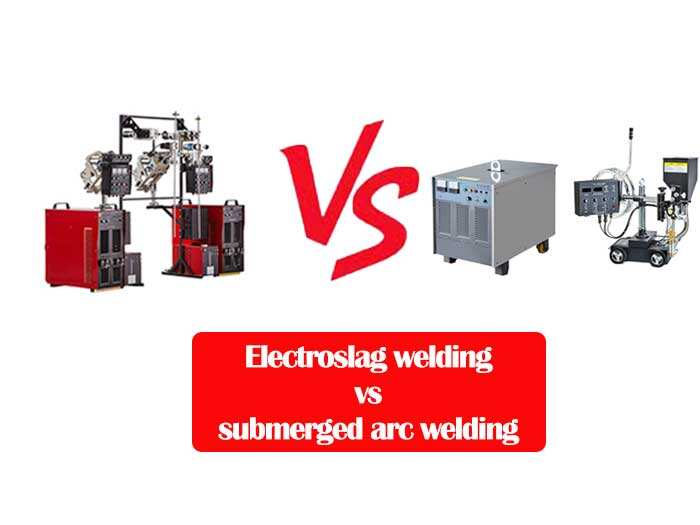
Box beam welding machines typically support submerged arc welding, gas metal arc welding, and flux-cored arc welding processes depending on the specific equipment configuration. These machines can automatically perform fillet welds, butt joints, and groove welds in various positions while maintaining precise control over welding parameters. The specific processes supported depend on the torch configurations and control system capabilities of the particular machine model.
Return on investment periods for box beam welding machines typically range from 12 to 36 months depending on production volume, labor cost savings, and quality improvement benefits. High-volume operations with significant manual welding labor costs often achieve ROI within 12 to 18 months, while moderate-volume applications may require 24 to 36 months. The calculation should include direct labor savings, quality-related cost reductions, and productivity improvements to accurately assess financial benefits.
Operators typically require 2 to 4 weeks of training to become proficient in basic box beam welding machine operation, including system setup, program selection, and routine maintenance procedures. Advanced programming and troubleshooting skills may require additional training depending on the complexity of the equipment and production requirements. This training investment is significantly less than the years required to develop skilled manual welders capable of producing equivalent quality results.
Modern box beam welding machines offer significant flexibility in handling various beam sizes and configurations through programmable positioning systems and adjustable tooling arrangements. Most systems can accommodate a range of beam dimensions and joint configurations through parameter adjustments and fixture modifications. The specific size ranges and configuration options depend on the machine design and can be customized to meet particular production requirements during the equipment specification process.

Since 1991, China IKING Industrial Group has been at the forefront of advanced welding technology. With a global presence and over 30 years of experience, we offer innovative solutions in submerged arc welding, electroslag welding, and stud welding. Our high-performance machines have empowered over 100 countries and key industries such as wind energy, shipbuilding, rail transport, and heavy machinery.
RM801-822, Hongxing Building 3, Linke West Road, Hedong District, Tianjin, China
Copyright © 2026 China IKING Industrial Group Co., Ltd. All right reserved Privacy Policy
 EN
EN