Manufacturing industries worldwide face increasing pressure to deliver high-quality products faster while maintaining cost efficiency. The demand for structural steel components in construction, shipbuilding, and heavy machinery has created an urgent need for advanced welding solutions that can handle complex geometries with precision and speed. Modern fabrication facilities are turning to specialized equipment that can automate traditionally labor-intensive processes, reduce human error, and significantly increase throughput without compromising weld quality.
The evolution of welding technology has transformed how manufacturers approach structural steel fabrication, particularly when dealing with box beam configurations commonly used in bridges, buildings, and industrial frameworks. Traditional welding methods often require multiple operators and extensive setup times, creating bottlenecks that limit overall production capacity. Advanced welding systems now offer automated solutions that can complete complex joints in a fraction of the time required by conventional approaches, while delivering consistent results that meet stringent quality standards across various industries.
Contemporary automated welding systems integrate sophisticated control mechanisms with precision positioning equipment to achieve optimal weld penetration and bead geometry. These systems typically feature multi-axis movement capabilities that allow welding heads to follow complex contours automatically, eliminating the need for manual torch manipulation. The integration of sensors and feedback loops enables real-time adjustments to welding parameters, ensuring consistent heat input and travel speed throughout the entire welding process.
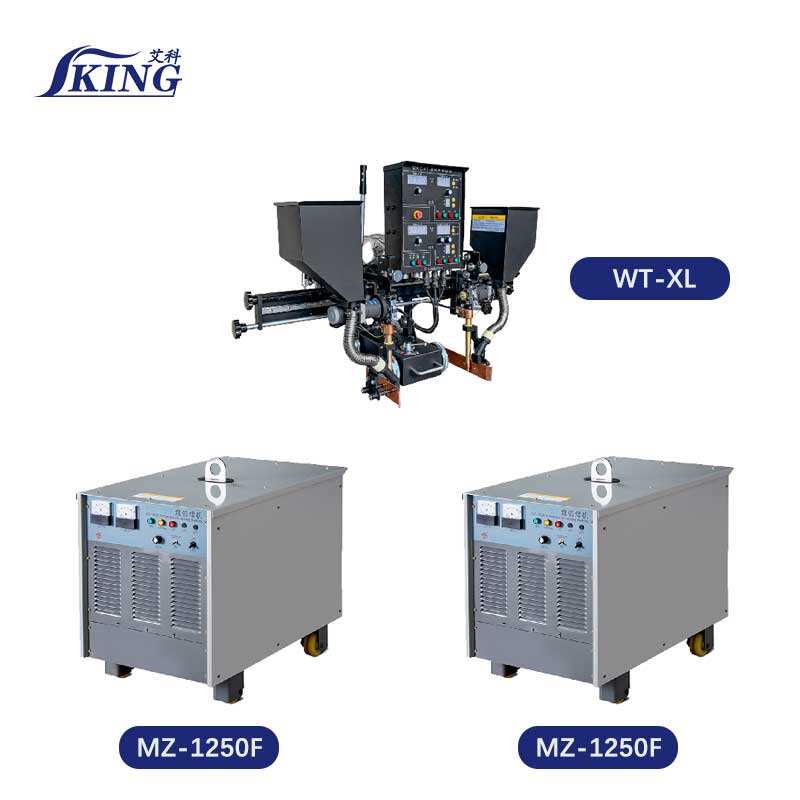
Advanced flux handling systems play a crucial role in maintaining weld quality by ensuring proper coverage and recovery during submerged arc welding operations. These systems automatically distribute flux ahead of the welding arc and collect unused material for recycling, reducing waste and maintaining consistent shielding conditions. The precise control of flux layer thickness directly impacts weld penetration characteristics and overall joint strength, making automated flux management essential for high-volume production environments.
Modern welding systems seamlessly integrate with existing production lines through programmable logic controllers and enterprise resource planning software. This integration allows for automatic job scheduling, parameter selection based on material specifications, and real-time production monitoring. Operators can program welding sequences for different box beam configurations and store these programs for future use, significantly reducing setup time when switching between different product types.
The ability to interface with material handling systems further enhances production efficiency by automatically positioning workpieces for optimal welding access. Robotic loading and unloading capabilities eliminate manual material handling, reducing cycle times and minimizing the risk of workplace injuries. These integrated systems can operate continuously with minimal human intervention, allowing manufacturers to maintain production schedules even during shift changes or break periods.
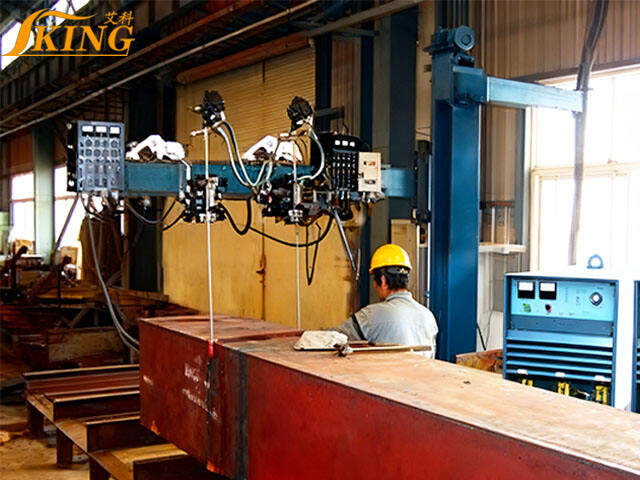
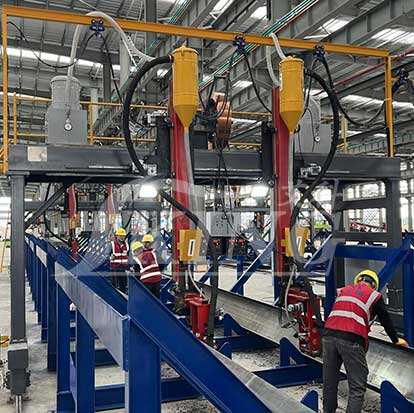
One of the most significant advantages of automated box beam welding machine systems is their ability to perform multiple welding operations simultaneously. Multi-torch configurations can weld both sides of a box beam concurrently, effectively doubling production speed compared to sequential welding approaches. This parallel processing capability is particularly beneficial when fabricating large quantities of identical components, as it maximizes the utilization of available welding power and minimizes total processing time.
Advanced systems can coordinate multiple welding stations to work on different sections of the same workpiece simultaneously, further accelerating completion times. Sophisticated control algorithms ensure that heat input is properly managed across all welding zones to prevent distortion while maintaining optimal travel speeds. This coordinated approach requires precise timing and thermal management but delivers substantial improvements in overall production throughput.
Automated systems can maintain consistently higher travel speeds than manual welding operations while ensuring complete penetration and proper fusion. The precise control of welding parameters allows for optimization of heat input ratios that maximize travel speed without compromising weld quality. Advanced algorithms continuously monitor arc characteristics and adjust current, voltage, and wire feed rates to maintain optimal welding conditions at higher speeds.
The elimination of human factors such as fatigue, inconsistent hand movements, and varying skill levels enables sustained high-speed operation throughout entire production runs. Automated systems can maintain peak performance levels for extended periods, resulting in significantly higher daily output compared to manual welding operations. This consistency is particularly valuable in high-volume production environments where maintaining steady throughput is essential for meeting delivery schedules.
Automated welding systems excel at maintaining identical welding parameters across multiple identical components, ensuring consistent weld quality throughout production runs. The precise control of current, voltage, travel speed, and wire feed rate eliminates the variations inherent in manual welding operations. This repeatability is crucial for structural applications where weld strength and penetration must meet specific engineering requirements consistently across all joints.
Digital parameter storage and recall capabilities allow operators to reproduce successful welding procedures exactly, even when switching between different operators or shifts. The ability to store and retrieve welding programs eliminates the trial-and-error period typically required when setting up new welding procedures. This consistency reduces the number of rejected parts and minimizes the need for rework, directly contributing to improved production efficiency and reduced manufacturing costs.
Modern welding systems incorporate sophisticated monitoring equipment that continuously tracks welding parameters and weld pool characteristics during operation. These systems can detect variations in joint fit-up, material thickness, or welding conditions and automatically adjust parameters to maintain optimal weld quality. Real-time feedback loops enable immediate corrections that prevent defects from propagating through long weld seams.
Advanced sensor technology can identify potential problems before they result in weld defects, allowing for proactive adjustments that maintain production flow. Vision systems can monitor weld bead appearance and geometry, providing immediate feedback on welding quality. This real-time quality assurance capability reduces the need for extensive post-weld inspection and helps identify process improvements that can further enhance production speed and quality.
The implementation of automated box beam welding machine systems typically results in substantial reductions in direct labor costs while improving overall production efficiency. These systems require fewer operators per welding station and can operate with less skilled personnel for routine operations, reducing training requirements and labor expenses. The increased production speed achievable with automated systems often allows manufacturers to complete more orders with existing equipment, improving capacity utilization without additional capital investment.
Reduced setup times and faster changeovers between different product configurations contribute to improved overall equipment effectiveness. Automated systems can switch between different welding programs in minutes rather than hours, enabling manufacturers to respond quickly to changing production requirements. This flexibility is particularly valuable in industries with varying product mix requirements, as it allows for efficient production of both large batches and smaller custom orders.
Precise control of welding parameters and consistent weld quality reduces material waste through fewer rejected parts and reduced rework requirements. Automated systems typically achieve higher first-pass success rates compared to manual welding operations, minimizing the material and labor costs associated with repair work. The ability to optimize welding procedures for specific materials and joint configurations helps maximize material utilization while maintaining required strength characteristics.
Automated flux recovery and recycling systems further reduce operating costs by minimizing consumable waste. These systems can recover and reuse a significant percentage of flux material, reducing the ongoing cost of welding consumables. The precise application of flux also ensures optimal protection of the weld pool while minimizing excess usage, contributing to both cost savings and environmental benefits through reduced waste generation.
The construction industry represents one of the largest markets for automated box beam welding technology, particularly for fabricating structural steel components used in buildings, bridges, and industrial facilities. These projects often require large quantities of identical or similar box beam assemblies, making them ideal candidates for automated welding systems. The ability to maintain consistent quality across hundreds or thousands of similar joints is crucial for meeting structural engineering requirements and building code compliance.
Infrastructure projects benefit significantly from the speed advantages offered by automated welding systems, as project schedules are often constrained by tight delivery requirements. The ability to accelerate fabrication without compromising quality helps contractors meet critical milestone dates and avoid costly project delays. Additionally, the consistency achieved through automated welding helps ensure that all structural components meet the same high-quality standards required for long-term infrastructure reliability.
Shipbuilding operations utilize box beam welding machine technology extensively for fabricating hull structures, deck frameworks, and other critical structural components. The marine environment places exceptional demands on weld quality, as joints must withstand dynamic loads, corrosive conditions, and extreme weather throughout the vessel's service life. Automated welding systems provide the consistency and penetration characteristics required for these demanding applications while significantly accelerating production schedules.
The complexity of ship structures often requires welding in various positions and orientations, making the flexibility of automated systems particularly valuable. Multi-axis welding capabilities enable optimal torch positioning regardless of joint orientation, ensuring proper penetration and fusion in all welding positions. This capability is essential for maintaining productivity when welding complex three-dimensional structures typical in modern ship construction.
The future of automated welding systems lies in deeper integration with Industry 4.0 concepts, including artificial intelligence, machine learning, and advanced data analytics. These technologies promise to further enhance production speed through predictive maintenance capabilities that minimize unplanned downtime and optimize welding parameters based on historical performance data. Machine learning algorithms can analyze thousands of successful welds to identify optimal parameter combinations for specific applications and material conditions.
Internet of Things connectivity enables remote monitoring and control capabilities that allow manufacturers to optimize welding operations across multiple facilities simultaneously. Cloud-based data collection and analysis can identify trends and opportunities for improvement that might not be apparent at the individual machine level. This connectivity also enables predictive maintenance scheduling based on actual usage patterns and performance trends rather than fixed time intervals.
Ongoing developments in welding technology continue to expand the capabilities of automated systems for handling advanced materials and specialized applications. New welding processes and consumables designed specifically for automated operation promise further improvements in speed, quality, and material compatibility. These advances enable manufacturers to take advantage of new high-strength, lightweight materials while maintaining the production speed advantages of automated welding systems.
The development of adaptive welding technologies that can automatically adjust to varying material properties and joint configurations promises to further enhance the flexibility and speed of automated systems. These adaptive capabilities will enable single systems to handle a wider variety of applications without requiring manual parameter adjustments, reducing setup time and improving overall productivity. Advanced sensor technologies continue to provide more detailed feedback on welding conditions, enabling even more precise control and optimization of welding parameters.
Automated box beam welding systems offer several key advantages including significantly higher welding speeds, consistent weld quality across all joints, reduced labor requirements, and the ability to operate continuously with minimal supervision. These systems can typically achieve 2-3 times faster travel speeds than manual welding while maintaining superior consistency and penetration characteristics. The reduction in human factors such as fatigue and skill variations results in more predictable production schedules and lower rejection rates.
Modern automated welding systems feature programmable positioning equipment that can accommodate a wide range of box beam sizes and configurations through software-controlled adjustments. Operators can create and store welding programs for different beam dimensions, wall thicknesses, and joint preparations, allowing quick changeovers between different product types. Multi-axis movement capabilities enable the welding equipment to automatically adjust for varying beam heights, widths, and lengths without manual repositioning.
Automated welding systems require regular preventive maintenance including cleaning of flux handling systems, inspection and replacement of wear components such as contact tips and nozzles, and calibration of positioning equipment. Most systems include diagnostic capabilities that monitor component condition and alert operators to maintenance needs before failures occur. Typical maintenance schedules include daily cleaning and inspection, weekly lubrication of moving components, and monthly calibration checks of welding parameters and positioning accuracy.
While automated box beam welding systems require significant initial capital investment, most manufacturers realize return on investment within 12-24 months through increased production capacity, reduced labor costs, and improved quality consistency. The ability to complete more work with fewer operators, combined with reduced rework and rejection rates, typically generates substantial cost savings that offset equipment costs relatively quickly. Additional benefits such as improved workplace safety and reduced insurance costs further enhance the overall economic value of automated welding systems.

Since 1991, China IKING Industrial Group has been at the forefront of advanced welding technology. With a global presence and over 30 years of experience, we offer innovative solutions in submerged arc welding, electroslag welding, and stud welding. Our high-performance machines have empowered over 100 countries and key industries such as wind energy, shipbuilding, rail transport, and heavy machinery.
RM801-822, Hongxing Building 3, Linke West Road, Hedong District, Tianjin, China
Copyright © 2026 China IKING Industrial Group Co., Ltd. All right reserved Privacy Policy
 EN
EN