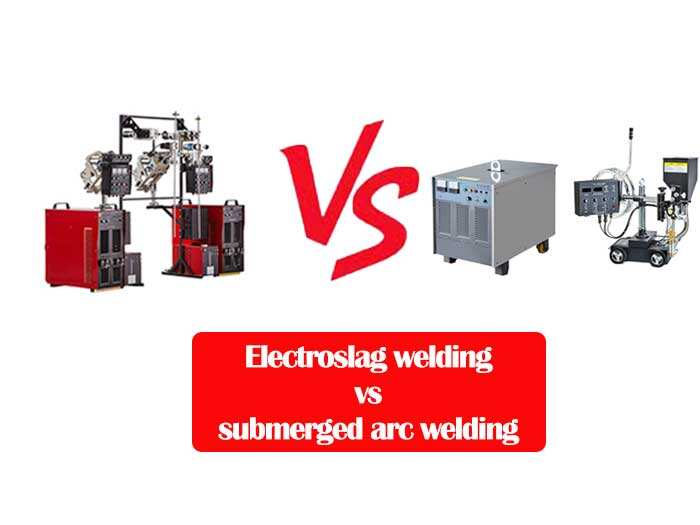
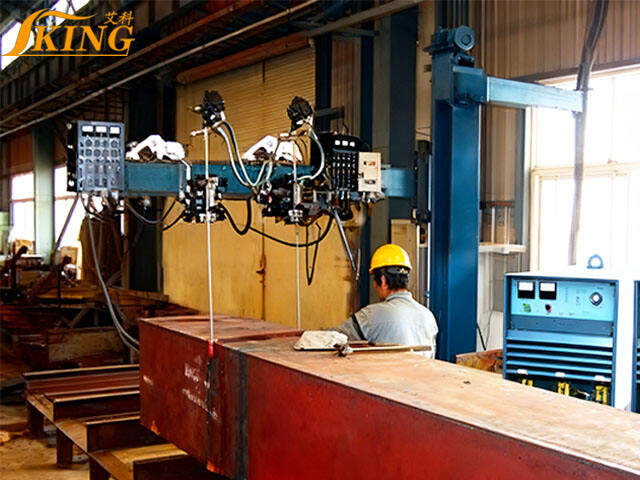
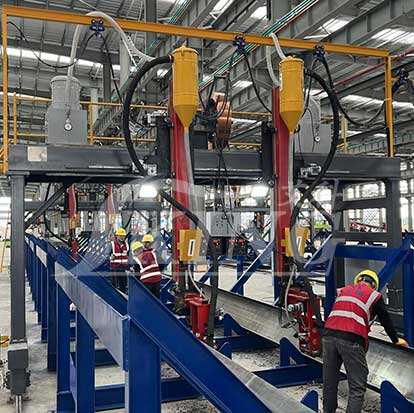
Industrial welding operations demand precision, efficiency, and reliability when fabricating structural steel components. The selection of appropriate welding equipment significantly impacts production quality, operational costs, and project timelines. Modern manufacturing facilities increasingly rely on specialized equipment designed for heavy-duty applications, particularly when working with complex structural elements. Understanding the various models available in the market enables manufacturers to make informed decisions that align with their specific operational requirements and production goals.
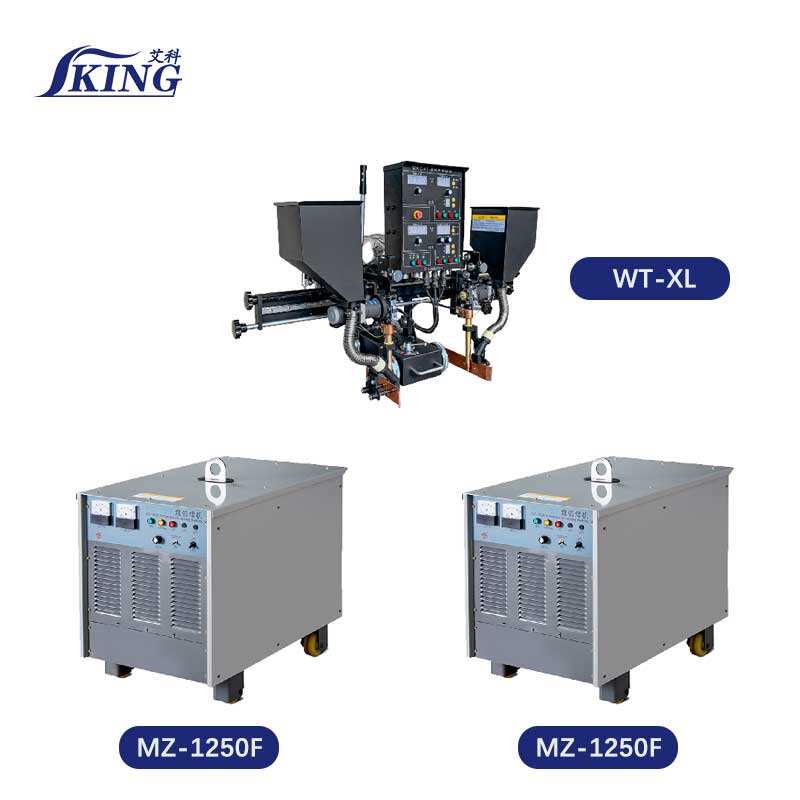
Box beam structures represent critical components in construction, shipbuilding, and heavy machinery manufacturing industries. These hollow rectangular sections provide exceptional strength-to-weight ratios while maintaining structural integrity under significant load conditions. The welding process for box beams requires specialized equipment capable of accessing internal surfaces and maintaining consistent weld quality throughout the entire structure. Professional welding systems incorporate advanced positioning mechanisms and automated controls to ensure uniform penetration and minimize distortion during the fabrication process.
The complexity of box beam welding stems from the need to create continuous, high-quality welds on both internal and external surfaces. Traditional welding methods often struggle with accessibility and heat management, leading to inconsistent results and potential structural weaknesses. Modern welding machines address these challenges through sophisticated design features including rotational capabilities, programmable welding sequences, and integrated cooling systems. These technological advances enable manufacturers to achieve superior weld quality while reducing production time and material waste.
Submerged arc welding technology offers distinct advantages for box beam fabrication, particularly in high-volume production environments. This process utilizes a continuously fed consumable electrode beneath a layer of granular flux, creating deep penetration welds with minimal spatter and excellent mechanical properties. The submerged nature of the arc provides superior protection from atmospheric contamination while enabling higher welding speeds compared to conventional methods. Industrial facilities benefit from reduced operator exposure to welding fumes and ultraviolet radiation, improving workplace safety and compliance with occupational health regulations.
The automation potential of submerged arc welding makes it particularly suitable for repetitive box beam production. Programmable welding parameters ensure consistent results across multiple units while reducing dependence on skilled operators. Advanced box beam welding machine models incorporate sophisticated control systems that monitor welding current, travel speed, and flux consumption in real-time. These capabilities enable manufacturers to maintain strict quality standards while optimizing production efficiency and minimizing operational costs.
Production efficiency represents a critical factor when evaluating different box beam welding machine models. High-performance systems typically achieve welding speeds ranging from 300 to 800 millimeters per minute, depending on material thickness and joint configuration. The ability to maintain consistent travel speed while delivering uniform penetration directly impacts overall productivity and cost-effectiveness. Modern machines incorporate servo-controlled drive systems that provide precise speed regulation and smooth acceleration profiles, reducing stress on mechanical components and extending equipment lifespan.
Advanced welding systems feature multiple welding heads that can operate simultaneously on different sections of the box beam structure. This parallel processing capability significantly reduces cycle times while maintaining weld quality consistency across all joints. Manufacturers benefit from reduced work-in-progress inventory and faster order fulfillment, particularly important in competitive markets where delivery schedules influence contract awards. The integration of automated material handling systems further enhances productivity by minimizing setup time and reducing manual intervention requirements.
Consistent weld quality remains paramount in structural applications where safety and reliability cannot be compromised. Leading box beam welding machine models incorporate advanced monitoring systems that continuously track welding parameters and detect potential quality issues before they affect the final product. Real-time feedback mechanisms automatically adjust welding current, voltage, and travel speed to compensate for variations in material properties or joint geometry. These adaptive control systems ensure uniform penetration and minimize the risk of defects such as lack of fusion or excessive reinforcement.
Quality assurance features include integrated inspection capabilities that document welding parameters for each joint, creating comprehensive traceability records. Some advanced systems incorporate ultrasonic or radiographic testing capabilities that provide immediate feedback on weld integrity without interrupting the production flow. These quality control measures help manufacturers meet stringent industry standards while reducing the need for costly post-weld inspection and repair operations. The documentation capabilities also support compliance with quality management systems and customer audit requirements.
The structural design of box beam welding machines directly influences welding accuracy and equipment longevity. Heavy-duty fabricated frames provide the necessary rigidity to maintain precise positioning during welding operations while accommodating the dynamic forces generated by the welding process. Premium models feature stress-relieved steel construction with reinforced mounting points for critical components. The foundation design incorporates vibration isolation systems that minimize the transmission of external disturbances to the welding process, ensuring consistent results even in demanding industrial environments.
Modular construction approaches enable manufacturers to configure machines according to specific production requirements and facility constraints. Expandable designs accommodate future capacity increases or process modifications without requiring complete equipment replacement. The accessibility of maintenance points and component serviceability significantly impact operational availability and lifecycle costs. Well-designed machines incorporate removable panels and strategically positioned access ports that facilitate routine maintenance and component replacement without extensive disassembly requirements.
Modern box beam welding machines rely on sophisticated control systems that coordinate multiple welding heads, positioning mechanisms, and auxiliary equipment. Programmable logic controllers with human-machine interfaces enable operators to configure welding sequences, monitor process parameters, and diagnose system faults efficiently. The integration of industrial ethernet networks facilitates communication with enterprise resource planning systems and quality management databases. These connectivity features support real-time production monitoring and enable predictive maintenance strategies based on equipment performance data.
Advanced control systems incorporate artificial intelligence algorithms that optimize welding parameters based on historical performance data and real-time process feedback. Machine learning capabilities enable continuous improvement of welding procedures while reducing the need for manual parameter adjustments. The integration of vision systems and sensors provides additional feedback for adaptive control algorithms, ensuring optimal performance across varying material conditions and joint geometries. These intelligent features reduce operator skill requirements while improving overall process capability and consistency.
The capital investment required for industrial box beam welding machines varies significantly based on capacity, automation level, and feature complexity. Entry-level systems suitable for small to medium production volumes typically range from $100,000 to $300,000, while high-capacity automated systems can exceed $1,000,000. The selection process must consider not only the initial purchase price but also installation costs, operator training expenses, and facility modifications required to accommodate the equipment. Financing options including equipment leasing and manufacturer financing programs can help distribute costs over time while preserving working capital for other operational needs.
Return on investment calculations should incorporate productivity improvements, quality enhancements, and labor cost reductions achieved through automation. Advanced welding systems typically reduce cycle times by 30-50% compared to manual welding methods while improving weld consistency and reducing rework requirements. The elimination of skilled welder positions in favor of machine operators can provide significant long-term cost savings, particularly in regions experiencing welder shortages. Energy efficiency improvements and reduced consumable usage further contribute to operational cost reductions over the equipment lifespan.
Ongoing operational costs include consumables, maintenance, energy consumption, and operator wages. High-quality box beam welding machine models typically demonstrate superior consumable efficiency through optimized welding parameters and reduced spatter generation. Maintenance costs vary significantly based on equipment design quality and operating conditions, with premium systems often featuring lower maintenance requirements due to robust component selection and superior engineering. Preventive maintenance programs and manufacturer service contracts can provide predictable maintenance costs while ensuring optimal equipment performance.
Energy consumption represents a significant operational expense, particularly for high-capacity welding systems operating multiple shifts. Modern machines incorporate energy-efficient power supplies and intelligent standby modes that reduce consumption during idle periods. The total cost of ownership analysis should consider utility rates, production volumes, and equipment utilization rates to accurately assess long-term operational expenses. Environmental considerations including waste reduction and emissions control may also influence operational costs through regulatory compliance requirements and environmental impact fees.
Evaluating box beam welding machine specifications requires careful consideration of production requirements, material specifications, and quality standards. Key technical parameters include maximum workpiece dimensions, welding current ranges, travel speed capabilities, and positioning accuracy. The compatibility with various electrode types and flux systems influences process flexibility and consumable sourcing options. Duty cycle ratings indicate the continuous operation capability under specified load conditions, critical for high-volume production environments requiring extended operating periods.
Environmental operating conditions significantly impact equipment performance and reliability. Machines designed for harsh industrial environments feature enhanced protection against dust, moisture, and temperature extremes. The availability of customization options enables adaptation to specific application requirements such as non-standard workpiece geometries or unique welding procedures. Integration capabilities with existing facility systems including cranes, conveyors, and quality control equipment influence overall system effectiveness and operational efficiency.
Comprehensive vendor support encompasses installation services, operator training, technical documentation, and ongoing maintenance support. Reputable manufacturers provide detailed installation guidelines and commissioning services that ensure proper equipment setup and initial performance verification. Training programs should address both operational procedures and basic maintenance requirements, enabling facility personnel to achieve optimal equipment utilization. The quality and completeness of technical documentation directly impact troubleshooting effectiveness and maintenance efficiency.
Long-term service support includes spare parts availability, technical assistance, and equipment upgrades. Manufacturers with extensive service networks can provide rapid response to equipment issues, minimizing production interruptions. The availability of remote diagnostic capabilities enables proactive maintenance and rapid fault resolution without requiring on-site service visits. Upgrade paths and modernization options help extend equipment life while incorporating technological advances that improve performance and efficiency.
The optimal machine size depends primarily on the maximum dimensions of box beams to be welded, production volume requirements, and available floor space. Larger machines accommodate bigger workpieces but require higher capital investment and more facility space. Production volume influences the need for automation features and multiple welding head configurations. Facility constraints including ceiling height, crane capacity, and utility availability also impact size selection decisions.
Maintenance requirements typically correlate with equipment complexity and build quality. Basic models require routine lubrication, consumable replacement, and periodic calibration. Advanced automated systems need additional maintenance for positioning mechanisms, control systems, and safety interlocks. Premium manufacturers often design equipment with extended maintenance intervals and improved component accessibility, reducing overall maintenance costs despite higher initial investment.
Essential safety features include emergency stop systems, light curtains or safety mats around the welding area, fume extraction systems, and proper electrical isolation. Automated systems should incorporate collision detection and safe positioning limits. Fire suppression systems and proper ventilation are crucial for enclosed welding areas. Training and procedural safety measures complement physical safety systems to ensure comprehensive workplace protection.
ROI timeframes typically range from 18 months to 4 years depending on production volume, labor cost savings, and quality improvements. High-volume operations with significant manual welding costs often achieve faster payback periods. Factors including reduced rework, improved throughput, and lower skilled labor requirements contribute to return calculations. Market conditions and competitive pressures also influence the economic benefits and payback timeline for automated welding investments.

Since 1991, China IKING Industrial Group has been at the forefront of advanced welding technology. With a global presence and over 30 years of experience, we offer innovative solutions in submerged arc welding, electroslag welding, and stud welding. Our high-performance machines have empowered over 100 countries and key industries such as wind energy, shipbuilding, rail transport, and heavy machinery.
RM801-822, Hongxing Building 3, Linke West Road, Hedong District, Tianjin, China
Copyright © 2026 China IKING Industrial Group Co., Ltd. All right reserved Privacy Policy
 EN
EN